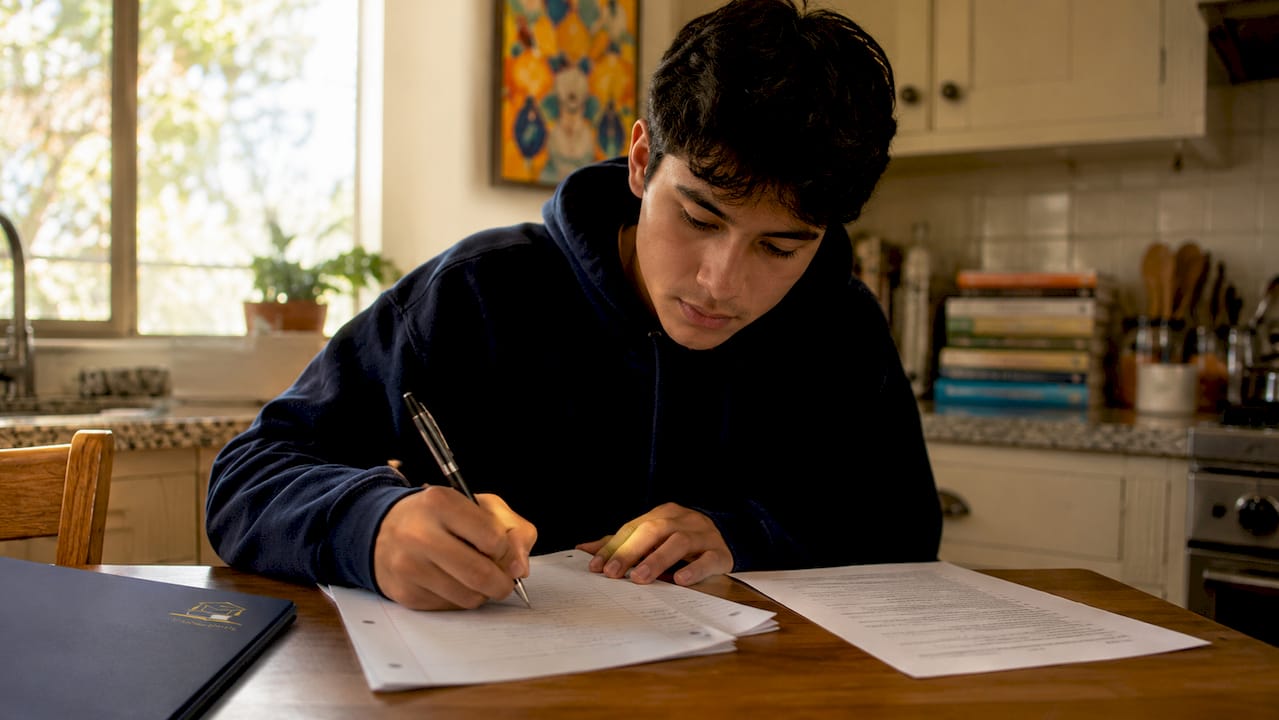
Personal narrative essays let students use a single lived experience as evidence for a larger claim about themselves or the world. The role of personal narrative essays in academic writing goes beyond storytelling. These essays build voice, practice rhetorical structure, and prepare students for college-level writing tasks. In short: a personal narrative is a rhetorical exercise, not a diary entry.
Primary functions of personal narrative essays:
- Form a rhetorical claim grounded in personal experience
- Practice organizational structure (scene, pivot, insight)
- Prepare for college application essays and later academic writing
Table of Contents
- What a personal narrative essay is
- Why instructors assign personal narrative essays
- What every strong personal narrative includes
- How to structure a personal narrative
- Personal narrative vs. personal essay: what is the difference?
- How instructors typically grade personal narratives
- A step-by-step writing and revision checklist
- What research says about narrative writing’s impact on learning
- Key Takeaways
- A tutor’s perspective on what students get wrong
- Improve your personal narrative with targeted tutoring
- Useful sources and further reading
- FAQ
What a personal narrative essay is
A personal narrative essay is a first-person, scene-driven, reflective piece of writing that also makes a claim. It is not simply a retelling of events. University writing centers define these essays as stories that communicate understanding of self, others, and society, and they recommend treating them as arguments with a thesis and a central conflict.
A short illustrative example: “The morning my father handed me his worn dictionary, I understood that language was not a gift — it was a responsibility.” That single sentence establishes scene, character, and an implied claim.
Instructors assign this form for several purposes: to persuade, to reflect, or to explain. Personal narratives are classified as creative nonfiction that blend story with reflection, and educators use them from elementary through college levels to teach craft and critical thinking.

Why instructors assign personal narrative essays
Understanding instructor intent helps students meet assignment expectations more precisely. Instructors assign personal narratives for specific pedagogical reasons, each tied to a measurable classroom outcome.
- Bridge to college rhetoric. First-semester composition courses use personal narrative as a Unit 1 assignment to connect students’ prior writing experience to college-level rhetorical skills. The narrative becomes a scaffold for rhetorical analysis later in the semester.
- Practicing voice. Students learn to write with authority and a distinct perspective. That skill transfers directly to argumentative and research writing.
- Practicing structure. Organizing a narrative around a pivot and insight teaches students how to sequence ideas purposefully, not just chronologically.
- Evidencing argument. Pedagogical literature frames personal narratives as argumentative vehicles where lived experience serves as evidence for a claim. The student’s story is not decoration; it is the proof.
- Identity exploration. Writing about personal experience helps students examine their values and assumptions. That reflection strengthens analytical thinking across subjects.
- Reducing writing anxiety. Because students write from their own experience, the assignment lowers the barrier to entry. Confidence built here carries into more formal writing tasks.
- Preparing for college applications. The skills developed in a classroom narrative, selecting a focused moment, building to an insight, showing rather than telling, are the same skills required for a strong Common App essay.
What every strong personal narrative includes
Strong personal narratives share a consistent set of craft elements. Each one contributes to both the reader’s experience and the instructor’s evaluation.
- Scene and setting. Ground the reader in a specific place and moment. Vague settings weaken the essay’s credibility and reduce sensory engagement.
- Sensory detail. Concrete details (sounds, textures, smells) make the experience real. Example: “The gym smelled of old rubber and chalk dust, and the fluorescent lights buzzed at a frequency that made concentration difficult.” The reader infers tension without being told it.
- Character (including the narrator). The narrator is a character who changes. Show the narrator’s assumptions at the start so the reader can track the shift.
- Conflict or tension. Every strong narrative has something at stake. The conflict does not need to be dramatic; it can be internal, a belief being tested, a decision being made.
- Pivot or insight. The moment the narrator’s understanding shifts. This is the essay’s core and the element instructors most often look for.
- Purposeful reflection. Reflection explains what the experience means, but it should be restrained. One or two sentences of direct reflection carry more weight than a full paragraph of over-explanation.
Pro Tip: Replace emotion labels with observable behavior. Instead of “I was nervous,” write “I checked my phone three times in two minutes.” Readers infer the feeling themselves, which is more persuasive than being told what to feel. During revision, cut any sentence that explains what the reader has already been shown.

How to structure a personal narrative
Structure is where most student narratives succeed or fail. A replicable outline:
- Opening scene. Drop the reader into a specific moment. No background history yet.
- Inciting moment. The event or realization that sets the conflict in motion.
- Rising action. Two or three focused scenes that develop the tension. Each scene should connect to the central conflict; cut anything that does not.
- Pivot. The moment of realization or change. Example pivot sentence: “Standing there, I realized I had been asking the wrong question the entire time.”
- Reflection and conclusion. A brief, direct statement of what the experience means. Avoid summarizing the story; state the insight.
Common organization mistakes to avoid:
- Chronological dump. Listing every event in order without selecting for meaning. Structure should serve the insight, not the calendar.
- Too many unrelated scenes. Each scene must connect to the central conflict or pivot. If a scene does not support the essay’s claim, cut it.
- No clear pivot. Without a pivot, the essay reads as a report, not a reflection. Identify the moment of change and build toward it.
- Over-explaining the insight. State the meaning once, clearly. Repeating it signals that the writer does not trust the reader.
Structure is iterative. Identifying the pivot late in revision, once you can see which scenes actually support the essay’s emerging claim, is normal. Be willing to reorder scenes for thematic clarity rather than chronological convenience.
Personal narrative vs. personal essay: what is the difference?
Students often use these terms interchangeably, but they describe related yet distinct forms. Knowing the difference helps when reading an assignment prompt.

| Feature | Personal Narrative Essay | Personal Essay |
|---|---|---|
| Primary focus | A specific event or experience | A theme, idea, or observation |
| Story vs. reflection balance | Story-forward, reflection at the end | More balanced or reflection-forward |
| Thesis placement | Implied through the pivot | Often stated more explicitly |
| Typical use | In-class assignment, college application | Literary publication, personal essay collections |
| Audience | Instructor, admissions committee | General reader |
| Rhetorical purpose | Reflect and argue through experience | Explore and argue through thought |
When to use each form:
- In-class reflexive assignment: Use the personal narrative structure. The instructor wants scene, conflict, and a clear pivot.
- College application essay: Narrative structure with a strong, explicit insight. The admissions reader wants to know who you are and how you think.
- Literary personal essay for publication: Lean toward the personal essay form. Reflection can be more expansive; the argument can be more openly stated.
If the prompt emphasizes argument, tilt toward an explicit thesis. If it emphasizes reflection, let the insight emerge from the scenes rather than announcing it.
How instructors typically grade personal narratives
Most instructors evaluate personal narratives using a rubric that covers five categories. Treat this as a self-evaluation checklist before submitting.
- Organization. Does the essay have a clear beginning, middle, and end? Is there a discernible pivot? Is the structure purposeful rather than chronological?
- Development and detail. Are scenes specific and concrete? Does the essay use sensory detail? Are claims supported by experience rather than assertion?
- Voice and authority. Does the writing sound like a distinct person? Is the narrator’s perspective consistent and credible?
- Sentence-level polish. Grammar, mechanics, and sentence variety. Errors at this level signal a lack of revision.
- Adherence to the assignment. Does the essay meet the stated requirements (length, prompt focus, format)?
A common teacher comment: “Your essay tells me how you felt but doesn’t show me the moment.” The revision action: locate the paragraph where you named an emotion and replace it with a scene. Show the moment that caused the feeling; cut the label.
Instructors weight reflection and story differently depending on the course level. In most high school and first-year college courses, rubric guidance emphasizes organization and development equally. The “so what” of the essay, the insight or claim, carries significant weight. Show it through the pivot; do not bury it in the final sentence.
A step-by-step writing and revision checklist
Follow this sequence from topic selection through final polish.
- Select a focused topic. Choose one specific moment, not a broad theme. “The summer I learned to drive” is too wide. “The moment I stalled the car at the intersection on Route 9” is workable.
- List the scenes. Write down three to five moments connected to that topic. Do not draft yet; just list.
- Identify the pivot. Before drafting, ask: what changed? What did I understand at the end that I did not understand at the start? That answer is your pivot.
- Draft the opening scene. Start in the middle of the action. No background, no history.
- Draft the body scenes. Write each scene with sensory detail. Do not explain the emotion; show the behavior.
- Draft the reflection. Write two to three sentences that state the insight. Then cut one of them.
- Revision pass 1: Read aloud. Any sentence that sounds awkward when spoken needs to be rewritten.
- Revision pass 2: Cut filler. Delete any sentence that restates what the reader already knows.
- Revision pass 3: Replace emotion labels. Find every instance of “I felt,” “I was,” or “I thought” followed by an emotion word. Rewrite with physical detail or action.
Micro-example: “I was sad when she left” becomes “I stood at the window for twenty minutes after her car disappeared, not moving.” The reader infers the sadness. The second version is also more specific and more credible.
- Peer feedback. Ask a reader: Where did you lose interest? Where did you want more detail? Where was the pivot unclear?
Pro Tip: Use a tool like Prose Coach to check whether your voice stays consistent across drafts. Inconsistent tone is one of the most common revision issues in student narratives, and it is easier to catch with a second set of eyes on the language.
What research says about narrative writing’s impact on learning
Research across multiple fields supports the classroom use of personal narratives. The evidence connects narrative writing to cognitive development, identity formation, and academic confidence.
- Higher-order thinking. Studies show that narrative contexts produce more higher-order thinking talk (HOTT) than non-narrative discourse. Narrative writing invites more metacognition and analytical reasoning. Practical takeaway: when revising, ask whether each scene requires the reader to infer, not just observe. That inferential demand is where the thinking happens.
- Reduced writing anxiety and college readiness. Personal narrative assignments in first-semester composition reduce writing anxiety and build confidence, according to course design research. Students who write narratives early in a course perform better on later analytical tasks. Practical takeaway: treat the narrative assignment as preparation, not a warm-up to skip.
- Curricular value in secondary education. Peer-reviewed scholarship argues that personal narrative strengthens argumentation when combined with personal experience and research. Removing narrative from composition curricula weakens students’ ability to use evidence from their own lives. Practical takeaway: the skills practiced here, selecting evidence, structuring an argument, are not separate from academic writing; they are the foundation of it.
- Identity and meaning-making. Research in narrative psychology, including work by Dan McAdams summarized in The Atlantic, shows that life stories are integrated narratives that shape meaning and values. Writing a personal narrative is not just a writing exercise; it is a way of constructing a coherent self. Practical takeaway: prioritize material in your essay that supports a clear insight. The scenes that do not connect to that insight are not just weak writing; they are noise in the story you are telling about yourself.
When deciding what to keep in a draft, use the research as a filter. Material that supports the pivot and the rhetorical claim belongs. Material that is interesting but disconnected does not.
Key Takeaways
Personal narrative essays serve as both a rhetorical exercise and a cognitive tool, requiring scene, a clear pivot, and purposeful reflection to function as argument rather than diary.
| Point | Details |
|---|---|
| Narrative as argument | Personal experience is evidence for a claim; treat the pivot as your thesis in action. |
| Five craft elements | Scene, sensory detail, character, conflict, and reflection are the components instructors evaluate. |
| Structure serves insight | Organize scenes around the pivot, not the calendar; cut anything that does not support the central claim. |
| Research-backed value | Narrative writing builds higher-order thinking, reduces writing anxiety, and prepares students for college rhetoric. |
| Davidtctutoringservices | Offers personalized sessions covering draft structure, pivot development, and line-level revision for personal narratives. |
A tutor’s perspective on what students get wrong
The three most common errors in student personal narratives are over-explaining feelings, unfocused chronology, and a missing or unclear pivot. Each has a direct fix.
Over-explaining feelings. Students write “I felt overwhelmed and didn’t know what to do.” The fix: delete the sentence and write the scene that caused the feeling. If the scene is strong, the emotion is already there.
Unfocused chronology. The essay covers three months of events because the student is afraid to cut. The fix: identify the one moment that changed something, then keep only the scenes that lead to or follow from that moment. Everything else goes.
Unclear pivot. The essay ends without a clear statement of what changed or what was understood. The fix: write one sentence that begins “What I understood then was…” and place it near the end. It does not need to be poetic; it needs to be clear.
In a tutoring session, a student once submitted a draft about learning to cook with her grandmother. The draft covered every visit over two years. After identifying the single moment, the first time the student cooked the dish alone after her grandmother’s death, the essay became focused and specific. The revision took forty minutes. The original draft was three pages; the revised version was one and a half, and it was stronger.
A 60–90 minute tutoring session on a narrative draft typically prioritizes in this order: identifying the pivot first, then cutting scenes that do not connect to it, then revising the opening scene for specificity, then addressing sentence-level issues last. Grammar is the last thing to fix, not the first.
Improve your personal narrative with targeted tutoring
Writing a personal narrative that works as both a story and an argument takes practice. Davidtctutoringservices offers personalized tutoring sessions focused on exactly the skills this essay form demands.

Sessions cover topic selection and focus, scene development and sensory detail, pivot identification and reflection drafting, and line-level revision for voice and clarity. For students preparing college application essays, the College Admissions Essay Coaching package applies these same narrative skills directly to the Common App. David has worked with students since 2012, and the approach is student-centered: each session addresses the specific draft in front of the student, not a generic template. Book a session to work through your draft with direct, specific feedback.
Useful sources and further reading
These sources provide additional depth on personal narrative essays, rubric criteria, and research evidence.
- Purdue OWL: Narrative Essays — The standard reference for narrative essay structure and purpose; covers point of view, tense, and organization with student-facing examples.
- San Jose State University Writing Center: Personal Narrative Essays — A practical handout defining conflict, thesis, and concrete detail; useful as a pre-submission checklist.
- Texas A&M ODP: Unit 1 Summative Assessment — Rubric and assignment rationale from a first-semester composition course; shows exactly how instructors frame and grade personal narratives.
- PMC: Personal Narrative as a Breeding Ground for Higher-Order Thinking — Peer-reviewed study on narrative’s cognitive benefits; supports the argument that narrative writing builds analytical reasoning.
- The Necessity of Narrative (Journal of Adolescent and Adult Literacy) — Peer-reviewed article arguing for personal narrative’s place in secondary composition; addresses digital contexts and argumentation.
- EBSCO Research Starters: Personal Narratives — Overview of personal narrative as creative nonfiction; covers structure, devices, and educational uses across grade levels.
FAQ
What is the main purpose of a personal narrative essay?
A personal narrative essay uses a specific lived experience as evidence for a claim about the writer, others, or the world. The goal is reflection and argument, not simply recounting events.
What are three key elements of a personal narrative?
Scene, conflict, and a pivot or insight are the three core elements. Scene grounds the reader, conflict creates tension, and the pivot delivers the essay’s meaning.
What are five elements of a personal essay?
A personal essay typically includes a central idea or theme, a first-person narrator, concrete detail, reflection, and a clear rhetorical purpose. The balance between story and reflection varies by form.
How does a personal narrative differ from a personal essay?
A personal narrative is story-forward, organized around a specific event with the insight emerging at the end. A personal essay is more reflection-forward, with the argument often stated more explicitly and the story serving the idea rather than the other way around.
How can tutoring help with personal narrative writing?
Davidtctutoringservices offers sessions that address the specific elements students struggle with most: identifying the pivot, cutting unfocused scenes, and revising for voice. Sessions are tailored to the student’s actual draft, not a generic outline.